
EPD Verification
Through a Verifier's Lens: Why EPDs Fail Long Before Verification
Most EPDs don't fail during verification — they fail months earlier, in the data. A look at where problems really start, and why EPDlogy exists.

İpek Göktaş Kalkan
21 July 2026 · 2 min read
Welcome to EPDlogy — a space where EPDs are seen through a verifier’s eyes.
Most EPDs don’t fail during verification — they fail months earlier
By the time a report reaches the verifier’s desk, the outcome is often already decided. The root cause of a weak EPD is rarely the audit itself — it’s the string of decisions made long before: how data was collected, which datasets were chosen, which assumptions were made, and how the standard was interpreted. Fixing these issues late in the process is slower and more expensive than getting them right from the start.
Where the issues really begin
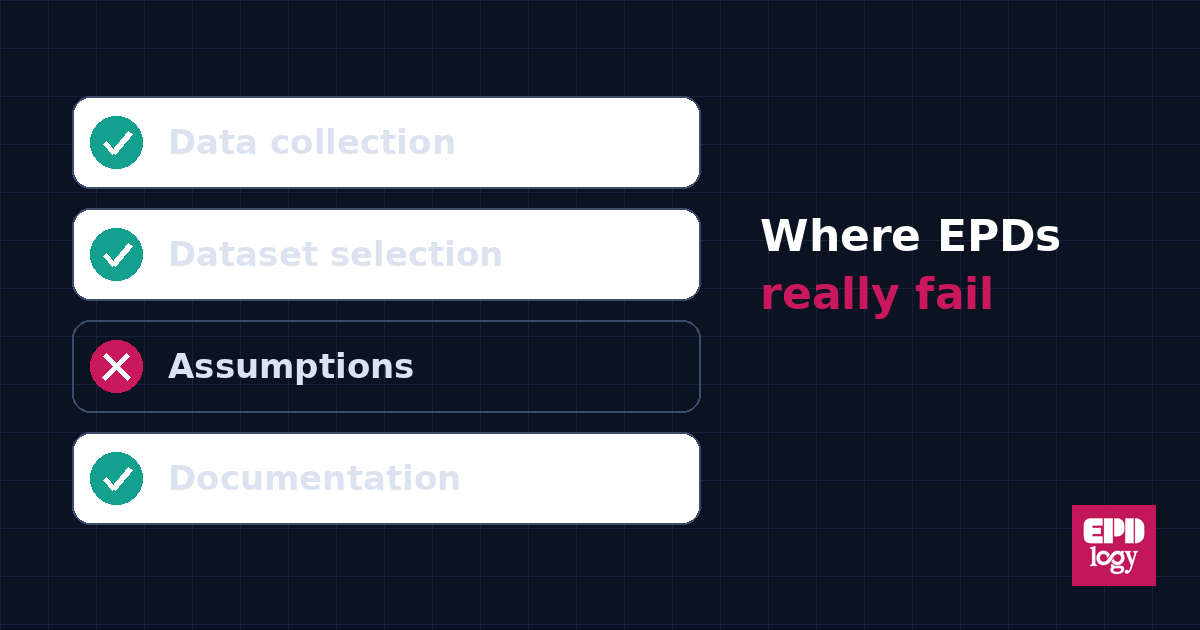
- Data collection — incomplete or unrepresentative production data quietly weakens the whole study.
- Dataset selection — a convenient background dataset is not always a representative one.
- Modelling assumptions — undocumented or unjustified assumptions are hard to defend later.
- Documentation — gaps and inconsistencies in the report create avoidable clarification rounds.
- Interpretation of standards — EN 15804+A2, ISO 14025 and ISO 14040/44 leave room for judgment, and that judgment has consequences.
Each of these, on its own, may look like a small shortcut. Together, they are why so many EPDs run into trouble at verification — not because the software got the maths wrong, but because the data and decisions behind it weren’t solid enough to defend.
That’s why EPDlogy exists
EPDlogy shares a verifier’s perspective before verification, not after — practical guidance on data decisions, dataset choices and documentation, so EPDs are built to hold up rather than patched to pass.
Follow EPDlogy for more insights from the verification side of the table.